
History often focuses on kings and queens, great battles and historic places, connected by dates and names. Far less attention is given to the half-forgotten people whose lives shaped the communities around them. Yet both are equally important.
Near the Northolme, two Delvers Blue Plaques stand within a stone’s throw of one another, celebrating individuals whose lives might otherwise have slipped from memory.
The stretch of land north of All Saints Parish Church, leading towards the Northolme football ground, is almost unrecognisable from the landscape that existed less than 80 years ago. Steeped in both fascination and notoriety, its history can be traced back to the original owners of the Old Hall.
The area also holds a personal significance. It was here that my mother, Thelma, was born during the early years of the Second World War. I asked her to close her eyes and picture herself as a little girl walking home. Old maps place her house opposite The Blues Club, on the land between Church Street and North Street. Today, little trace remains, but its story survives in engravings, historic maps and a handful of paragraphs in local history books.
At the Elm Cottage Pub, a Delvers Blue Plaque quietly announces that in this vicinity Lord Thomas Burgh established almshouses in 1496, which later became the town Poor House and the site of the House of Correction. But maps are not memories.
“My house was not on Church Street. I had to go to North Street to get in,” Thelma said. The correction came almost immediately. I put my documents aside and followed her.
“Two steps led down from North Street. Then a gate, a small entrance and the front door. The house was large, although by the 1940s it had long since been divided. Its arrangement was strange. Rooms and passages that seemed to belong to an earlier purpose.” Thelma did not know why.
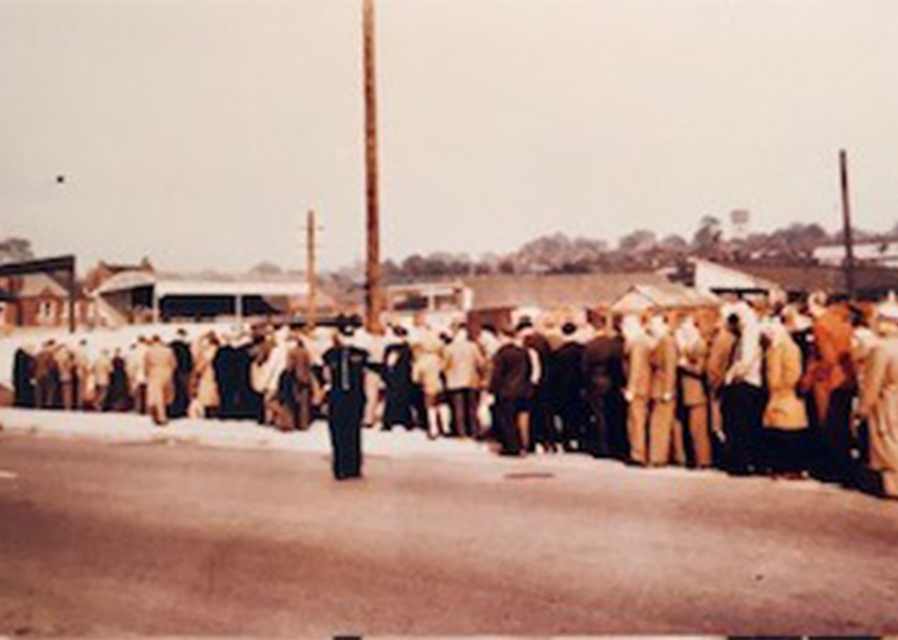
She had been born there, in an upstairs bedroom overlooking the football ground. From that bedroom window, every Saturday, Thelma could hear the hammering of iron on the anvil at Chris Lambert’s blacksmiths on the corner of Carlisle Street. Smoke billowed out towards the noisy line of people on the opposite side of the road. Children pushed prams, trolleys and homemade carts, moving patiently down the line. All waiting to collect coke from the gasworks.
No sooner had the gasworks doors closed at noon than another queue began to form; this time clicking through the turnstiles of the Northolme, before the sound of the referee’s whistle cut through their chatter. A Delvers Blue Plaque dedicated to the remarkable talent of Fred Spiksley marks this historic site.
Walking through that old house and leaving by the back door, another landscape appeared. A great square, often muddy after rain. Along one side stood a laundry room, shared with Mrs Reggler and Mrs Ashworth, each allocated different washing days. There was a cold-water tap and a large tub collecting rainwater. Dustbins stood nearby, although during the war scraps of food were always saved until a man came to collect them for his pigs. There were outside toilets. To reach them, Thelma passed a large bush. At night, she hurried, frightened by its shadow and her imagination.
Beyond the bush were piles of bricks. All that remained of Albert Square, the Victorian name given to the place because no-one liked the thought of living in Old Workhouse Yard. Children sometimes climbed across the bricks and rubble to reach Gasworks Passage.
Almost five centuries earlier, one of the most powerful men to call Gainsborough home contemplated how he should be remembered after his death.
Lord Thomas Burgh had survived the Wars of the Roses. He had served Edward IV, known the world of Richard III, and adapted successfully to the arrival of Henry VII. He became Lord Burgh of Gainsborough and a Knight of the Garter. His great house survives today as The Old Hall. In his will he ordered the establishment of an institution for five poor men, “for evermore”. They would receive a penny each day and, every other year, a new gown. Preference was to be given to his former servants and then to his tenants, if they had fallen into poverty. In return, they would be required to pray for the soul of Lord Burgh, his wife Margaret and their ancestors.
It would be easy to judge this transaction through modern eyes: charity intertwined with salvation and self-interest. Perhaps it is enough to recognise what his arrangement tells us about his world. Poverty, obligation, faith and memory. All bound together.
The names of the five poor men, unlike Lord Burgh’s, have largely disappeared. As centuries passed, religious beliefs changed. Chantries were swept away. Lord Burgh’s stone monument was destroyed and the provision for the poor eventually became centrally organised.
By the 18th century it had become the site of the town Poor House. Adam Stark, writing in the 19th century, described a neat square with a small garden at its centre, surrounded by buildings. He believed part of the low range had once belonged to Burgh’s original almshouses. Yet other functions clustered around the Poor House.
In 1789, officials came to inspect the lock-up, otherwise known as the House of Correction. Their report survives. What they found was damning. The prison usually held 24 to 30 people. Three-quarters were usually men. The main square measured just over 30ft. Opening from it were several rooms, including a day room only 14ft long, nine feet wide and seven feet high. On the day of the inspection, 11 prisoners were crammed inside it. The committee described the room as “dark and close”. Their conclusion was that the House of Correction was “thoroughly insufficient”, and their recommendation was that the building should be closed, sold off, and a new House of Correction, complete with court facilities for the quarter sessions, be constructed at nearby Kirton in Lindsey.
In 1826, John Mallam’s gasworks was established, almost adjoining the Poor House. The town was entering a new age. Gas brought light, industry promised progress, changing Britain at extraordinary speed. Yet progress always looks different from the back door. Stark records two men suffocating in a tar well at the gasworks in 1837. Almost a century later, the works had become so embedded in the landscape that Thelma simply knew one of her childhood routes as Gasworks Passage.
Names sometimes outlive the worlds that created them. Sir Charles Anderson, a familiar name in the Delvers Blue Plaque series, now unexpectedly begins to move through this story. Sir Charles family’s ownership of Lea Hall could be traced back to the Dallisons and the Burghs. Anderson became a magistrate and eventually Chairman of the Lindsey Quarter Sessions. In 1847 he sat in judgement on 12-year-old Charles Jackson of Gainsborough, convicted of stealing half an ounce of manufactured tobacco worth one penny. The boy was found guilty and incarcerated at the Kirton House of Correction for a week’s hard labour and a private whipping.
This was the same Sir Charles whom I had followed across the North Sea, travelling through Scandinavia. He inhabited a Britain increasingly connected to the wider world, confident in its institutions and fascinated by progress. Yet back home another Britain existed.
One where poverty walked in the shadow of progress. Sir Charles seems almost to bridge the two worlds. Following his Nordic journey, he was a steward at the town’s Annual December Ball. The venue was the Old Hall.
Sir Charles, living on an estate once connected with the Burghs, danced and entertained inside the surviving great house of Lord Thomas Burgh, while only a short distance away, the remnants of Burgh’s provision for the poor followed an altogether different journey.
The Old Hall survived. The Poor House and House of Correction did not. No version of history records the little girl playing in Albert Square; until now.
The old adjacent building became the place where her father worked on second-hand cars. The family had the keys. Once inside, Thelma could see broken glass overhead, an old-fashioned typewriter, lock-up garages and a strange type of uneven paving, that went beneath her feet into North Street. She knew nothing of its history, only thinking: “This is a terrible place. Something horrible has happened here.”
Much later in life, Thelma researched the buildings and their connection with the old House of Correction. Whether every wall she remembered belonged precisely to that institution can no longer be established. Memory and evidence should never be made to say more than they can. The child experienced the building first. The historian came much later.
Eventually, almost everything disappeared. The cottages went. Albert Square vanished. Industry changed and streets were redeveloped. Today it is difficult even to judge exactly where the square began or ended. Blocks of flats now occupy much of this landscape. And that is why the Delvers Blue Plaque on the side of Elm Cottage matters.
History usually invites us through the front door. There we meet kings, judges and institutions. Their names fill documents. But occasionally we find another entrance. I asked Thelma to close her eyes because I wanted her to remember a building. Instead, she opened a door into a half-forgotten landscape.
Once again, she was a little girl at 93 North Street. Two steps. A gate. The screams of the football crowd beyond the window. The hammer of the blacksmith. Around her lay almost 500 years of unbroken history: Lord Burgh and his five poor men; prisoners crowded into a dark room; Mallam’s gasworks; Sir Charles Anderson and a 12-year-old boy sent to Kirton.
Most of it had disappeared before she understood what it meant. History preserves one version of the past. Memory preserves another.
To find out more about the 30th anniversary of The Delvers Blue Plaque collection and their Festival of Memories, visit The Delvers Facebook page, or email chilcom@icloud.com.