
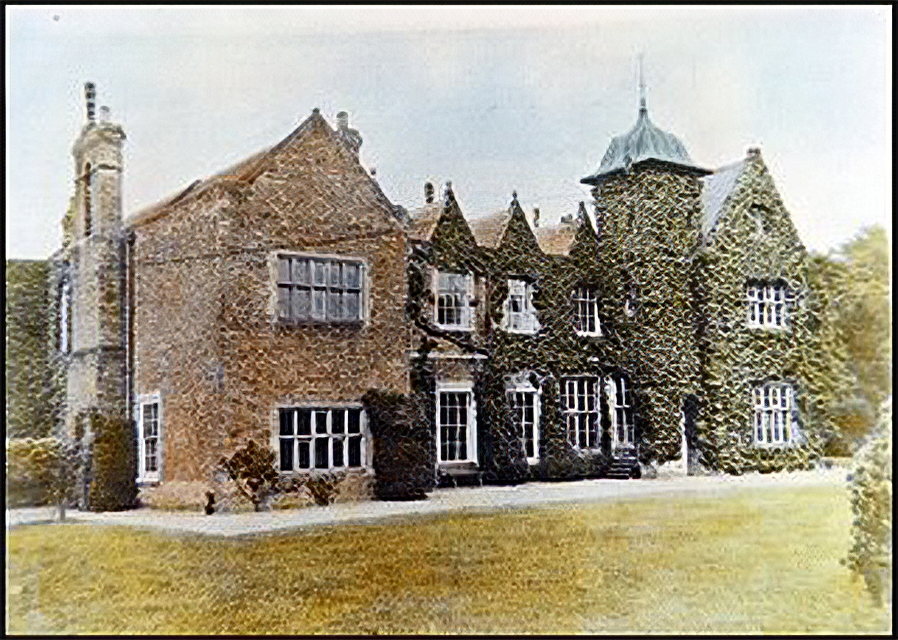
In my last feature I told the story of Sir Charles Anderson and his two Nordic voyages, describing him as a traveller through time. His name is remembered on a Delvers blue plaque at Lea Park, where the Anderson family home once looked out towards the River Trent. It serves as a reminder that history is often defined as much by what it forgets as what it chooses to remember.
Sir Charles’ remarkable life spanned most of the nineteenth century. Since I wrote The Last Baronets of Old Gainsborough (Childs, 2012) the more convinced I have become that his life divides naturally into two distinct halves. The first belonged to youth: a world of confidence, travel and expectation. The second became increasingly defined by responsibility, social change and deep personal loss.
By the time of the Great Exhibition in 1851, Sir Charles had reached the pinnacle of his public life. Five years earlier he had inherited the Anderson baronetcy and Lea Hall estate and now served as High Sheriff of Lincolnshire. Yet beneath the confidence of Victorian Britain, an England shaped by industrialisation, poverty and social reform was beginning to emerge.
Only days before Sir Charles departed on his second Nordic journey in June 1852, unrest erupted across the Isle of Axholme. What began as a political gathering quickly descended into violence. Windows were smashed, troops were deployed and magistrates struggled to restore order. Contemporary newspapers recorded confusion and alarm.
History encourages us to imagine lives unfolding separately. In reality they overlap. While crowds gathered in Epworth, Sir Charles packed his trunks. While officials attempted to restore order, favourable winds were awaited at Spurn Point. Within days he had sailed north, leaving behind an England that was already beginning to change.
Looking back, that second voyage feels less like the start of another journey and more like the closing of one life before another quietly began. After his return, the world he had always known gradually began to disappear. Nothing illustrates that transformation more profoundly than the life and loss of his younger sister, Emily Margaret Charlotte Anderson.
Born at Lea Hall in 1817, Emily belonged to a privileged family whose influence extended across much of Lincolnshire. She could easily have lived a quiet life within the boundaries expected of a Victorian lady. Instead, she chose another path.
When Asiatic cholera struck Leeds during the summer of 1854, Emily stepped forward. Few women of her social standing would have volunteered to enter the infected districts.
The epidemic swept through overcrowded homes where poverty, contaminated water and poor sanitation combined with devastating effect. Here she met suffering at its most immediate, learning practical nursing long before such work carried any professional recognition.
That experience changed everything. Later that same year, Florence Nightingale and Mary Stanley sought women capable of serving in the military hospitals of the Crimea. Emily’s work during the Leeds epidemic brought her to their attention. Supported by the Bishop of Oxford and Earl Nelson, she joined the nursing contingent that sailed east in December 1854.
Official records preserve only brief remarks, yet they speak volumes. Florence Nightingale’s own register records Emily Anderson as an “admirable nurse”, noting that she was later invalided home after suffering the “most severe illness” at Therapia. Those few words conceal months spent amongst the overcrowded military hospitals at Scutari and Koulali, where disease claimed more lives than Russian gunfire.
Emily eventually returned to Lea Hall, but never truly recovered. The battlefield had been left behind, but its consequences travelled home with her. Long after the Crimea disappeared from the newspaper headlines, the war continued quietly inside those who had survived it. Unlike Florence Nightingale, whose work continued from London, Emily’s remaining years were devoted quietly to Lincolnshire. Her experience of war reshaped her understanding of care. She became closely associated with improvements at the Union Workhouse, where she supported the provision of a chapel for those who had little else. More significantly, she became the driving force behind establishing a Lincolnshire Convalescent Home on the seafront at Mablethorpe.
Here another remarkable thread appears. Emily’s own fundraising letters survive, together with Florence Nightingale’s correspondence commenting upon the architectural plans. The principles first learned amidst the suffering of the Crimea were finding new expression on the Lincolnshire coast.
Emily would never see that work completed. She died at Lea Hall on 30th August 1870, aged just 53. Her death certificate records the cause simply as “Diseased Heart, not Certified”. No evidence can conclusively prove that this illness caused her early death. Yet the chronology is difficult to ignore. A healthy woman left England in 1854. She returned permanently broken, spending the next 15 years living with declining health whilst continuing to serve others.
Her death came during one of the darkest periods of Sir Charles’ life. Only weeks earlier he had buried his wife, Emma. Before the autumn was over, he would also lose a daughter. The confident young traveller who had once crossed the Baltic had become an old man surrounded by absence.
There is one final connection. The Crimean War brought another survivor back to Gainsborough: a captured Russian cannon from Sebastopol. For decades it stood proudly in the Market Place before later being moved to the Union Workhouse. Eventually it too disappeared, melted down during the Second World War.
Today, only a blue plaque marks the place where both the workhouse and the cannon once stood. Standing there recently, outside the entrance to Aldi on Lea Road, I realised something I had never fully appreciated. The blue plaque remembers the cannon; it remembers the workhouse. Yet it says nothing of Emily Anderson.
That is how history works. It finds room for monuments and buildings, while quieter lives slowly fade beyond memory. Yet without Emily there would have been no chapel, no convalescent home, no surviving correspondence with Florence Nightingale and no Lincolnshire chapter in the wider story of modern nursing.
The cannon has now gone. Lea Hall has gone. The convalescent home and the workhouse are no more. But memory has a curious way of returning. Sometimes it survives in a faded letter. Or it resurfaces in a half- forgotten story, hidden within the pages of Florence Nightingale’s register. Sometimes memory waits patiently behind an ordinary blue plaque, quietly asking not only what history remembers, but who it leaves behind.