
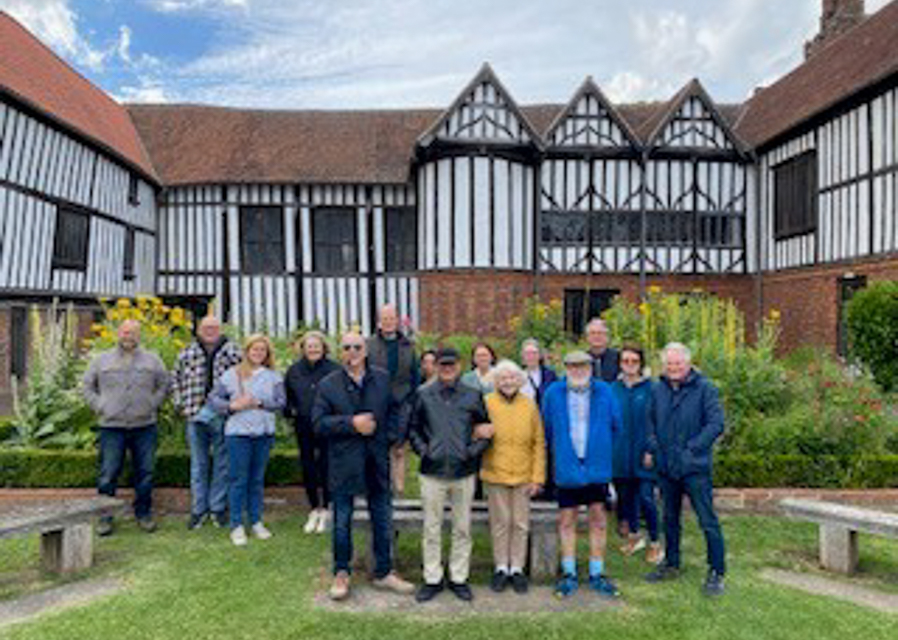
Some history groups are founded in libraries or committee rooms. The Delvers began somewhere far less formal – on the stage. Forty years ago, what would become Gainsborough’s longest-standing active research group grew out of a travelling historical theatre project that toured the county, keeping local memories alive through performance. Stories were spoken aloud rather than footnoted, characters were embodied rather than catalogued, and history was something to be experienced rather than simply read.
When the theatrical Gainsborough Reminiscence Project came to an end, its producer, Peter Spafford, asked a simple but pivotal question of its youngest member, Thelma Childs: could she keep the group going? The first meetings at the John Robinson Memorial Hall were sparsely attended and it seemed possible that the Delvers might fold. Thelma’s persistence and enthusiasm, however, ensured otherwise. Four decades later, she remains one of the longest-serving members, having carried the group’s purpose through changing venues, formats and generations. Over the years, a wide range of people has passed through the Delvers – teachers, writers, researchers, performers and curious locals – all united by the same instinct to look beneath the surface and ask what once stood there, who lived there and why it still matters.
That theatrical DNA has never quite left. The Delvers have always understood that history lives best when it is shared, told and, at times, performed.
It therefore feels fitting that the group is returning to one of its spiritual homes. Earlier this winter, the Delvers completed the third of their Riverside talks at Café Walton, where local stories performed by Darron Childs came alive beside the River Trent. Their next season of monthly discussions and talks will recommence in March at the Old Nick Theatre, in association with the Delvers’ face-to-face fellowship group. This is not the first time that dramatic storytelling has been used to share Delvers’ research. Twenty years ago, Darron wrote the script for The Old Town Ghost Trail, an innovative blend of street theatre and historical storytelling that brought true local stories to life through characters who once walked the streets of Gainsborough. Thousands of people took part in the Ghost Trail, which later received a tourism award.
The Delvers have also installed 17 blue plaques across the town, all self-funded through talks, slide shows and events. These plaques commemorate significant people and places and together form part of a much larger, often overlooked, story of Gainsborough. Meetings at the Old Nick Theatre will take place on the last Thursday of each month from 2.00pm to 4.00pm, and both existing and new members are welcome. The programme reflects the breadth that has always defined the Delvers’ approach. On Thursday 26th March, Paul Reynolds will present The Pubs of Old Gainsborough, followed on Thursday 30th April by George Eliot and The Mill on the Floss with Helen Hagon. Both subjects are marked by Delvers blue plaques. Different centuries and different perspectives are brought together by the same sense of curiosity.
As the Delvers approach their 40th anniversary, what stands out is not just their longevity but the continuity of their purpose. During the Covid period, the group launched an online community to engage a wider audience while continuing to adapt to new media, new spaces and new ways of sharing research. Throughout these changes, the belief has remained that local history is not static. It needs to be revisited, retold and sometimes re-imagined if it is to stay alive. This approach was evident during the February Riverside talk, where Darron shared findings from his MA research, re-telling a Viking-Age story for a contemporary audience.
From touring theatre to riverside talks, from ghost trails to afternoon discussions, the story of the Delvers mirrors that of the town itself – layered, resilient and shaped by people willing to keep asking questions. Further details about meetings and events can be found via the Delvers’ Facebook online community.