
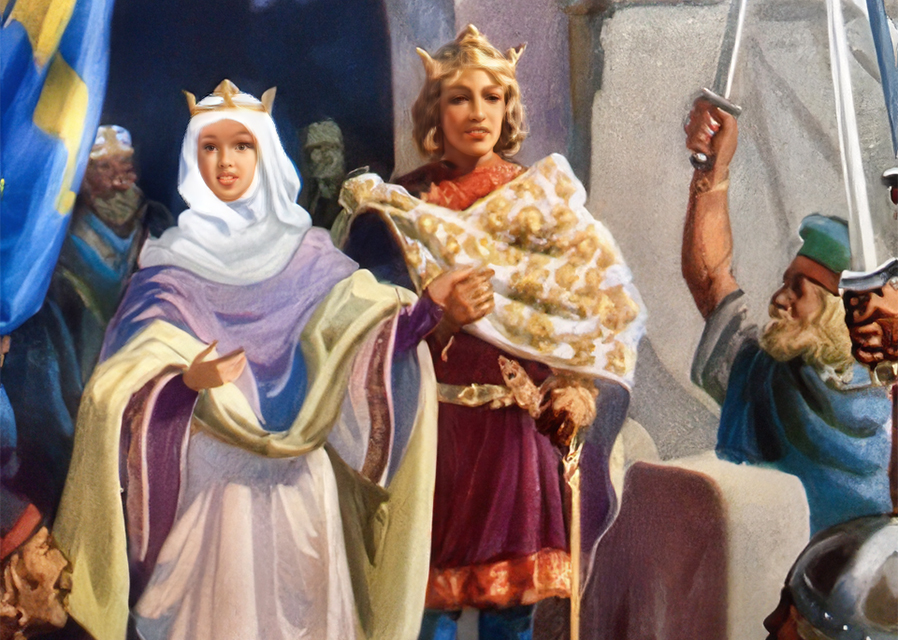
On the corner of a Georgian building that gazes towards the River Trent at Gainsborough, is a blue plaque with an unusual name. Those stopping to read the inscription usually know surprisingly little about her. She has always been known as Elswitha locally, yet the chronicles records her name in old English as Eahlswith. When she died in December 902, she was described in the Anglo-Saxon chronicle as ‘the true and dear Lady of the English’.
For many years I have been fascinated by her. Yesterday, I walked the old bridge at Tamworth and stopped midway. Below, the River Tame appeared to divide. One channel continued beneath the bridge while another curved away towards the Anker, the two waterways meeting beside the ancient town before beginning their longer journey towards the Trent. It was a sight that felt strangely familiar. Not because Tamworth resembled Gainsborough, but because the river appeared to be telling the same story. Rivers disregard the boundaries that later generations draw upon maps. Long before England existed – before counties, kingdoms or even Mercia itself – the water discovered its course through the landscape. People merely followed. Perhaps that is why I have come to regard rivers not as barriers, but as corridors of memory.
Tamworth proclaims itself the ancient capital of Mercia. Its Norman castle rises above the confluence of the Tame and Anker, reminding visitors that this was once among the most important places in Anglo-Saxon England. Yet, as I crossed the bridge, I was reminded of another place. Tamworth and Gainsborough have more in common than first appears. Both emerged as Anglo-Saxon towns. Both were founded beside navigable rivers. Both prospered because water carried people, goods and ideas. Both belonged to the Mercian world. And both, during very different periods, have claimed to be capitals. Tamworth was the enduring royal centre of Mercia. Gainsborough, 40 extraordinary days, became the headquarters of Sweyn Forkbeard’s Anglo-Danish empire.
One was a capital formed over generations. The other existed between just Christmas and Candlemas, 1014. But power passed through both – as did the river.
The Tame flows into the Trent, whose waters continue northwards past the river town before reaching the Humber and the North Sea. From the bridge, Tamworth and Gainsborough no longer appeared to be two isolated places. They belonged to the same ancient system – a river corridor connecting the Midlands to the sea.
Before kingdoms united, the rivers already had.
It was while thinking about these connections that I recalled another; the extraordinary women that influenced the first King of England.
We usually approach Anglo-Saxon history through its kings: Offa, Alfred, Edward, Æthelstan and Sweyn. Their names provide the fixed points around which the period is arranged. Yet the dynastic alliances that gradually drew the kingdoms together were often embodied by women whose names were relegated into the margins. One such woman was King Alfred the Great’s sister, Æthelswith. In 853 she married King Burgred of Mercia. In other words, Wessex married into Mercia. In 868, Alfred married Ealhswith, daughter of Æthelred Mucel, the Ealdorman of the Gaini. Ealhswith was not the convenient bride of a West Saxon prince. She belonged to one of the most distinguished families of Mercia, and her marriage helped bind the two courts during one of the most dangerous periods, as Viking age invaders began encroaching into the kingdom of Mercia.
The symmetry is striking. Wessex married into Mercia; Mercia married into Wessex. What looks like family history when viewed from a distance, is actually the gradual weaving together of the future English nation.
Eahlswith’s father’s position within the people of the Gaini, gives the town its place name. Not merely an obscure tribe dwelling beside the Trent, but close enough to Mercian power to provide Alfred with his bride. Yet Ealhswith remains almost absent from the story traditionally told about her husband. Annie Whitehead, in Women of Power in Anglo-Saxon England, observes the irony that the wife of one of the best-known Anglo-Saxon kings was kept out of the records by those around her. Even Asser, Alfred’s biographer, described her ancestry and praised her mother, yet did not record Ealhswith by name. It is one of history’s familiar disappearances. The woman is present in the dynasty – but almost absent from written memory.
Her influence endures through her children. Her son Edward succeeded Alfred. Her eldest daughter, Æthelflæd, inherits something from both sides of the marriage: the West Saxon dynasty of her father and the Mercian identity of her mother.
Æthelflæd married Æthelred, Lord of the Mercians, and eventually ruled Mercia in her own right. From 911 until her death she fortified towns, negotiated alliances and helped drive Viking power away from the Midlands. Her programme of burh building included Tamworth, Stafford and Warwick, while her authority was recognised far beyond. In 909 the bones of Saint Oswald were removed from Bardney and carried to Gloucester at Æthelflæd’s instigation. The saint’s remains were placed in the minster she established with her husband, where he would later be buried. When Æthelflæd died at Tamworth in June 918, her body was taken back to Gloucester and laid beside him.
Medieval people understood something that we often forget. To possess the remains of a saint was to alter the meaning of a place. Sacred memory could be carried from one landscape into another, just as authority, marriage and royal identity were carried between kingdoms.
Æthelflæd also appears to have nurtured another inheritance. According to a later tradition preserved by William of Malmesbury, her nephew Æthelstan – the eldest son of Edward the Elder – was raised at the Mercian court of Æthelflæd and her husband. If this later tradition is correct, it was Æthelflæd who helped raise the young Æthelstan. But behind Æthelflæd was her mother.
Ealhswith raised the woman who in turn, helped shape the first king of England. The statue on a stone pillar that sits below Tamworth castle preserves one memory. The Delvers blue plaque recalls another. From mother to daughter, from daughter to nephew. A quiet line of female transmission leading towards Æthelstan, the first king of all England who reigned 1100 years ago.
Ealhswith outlived Alfred the Great by three years. In his will she received estates of profound personal and dynastic significance. As a widow she became associated with the religious house later known as the Nunnaminster at Winchester. In 901 she witnessed a charter of her son Edward, appearing immediately after the king as Ealhswith, mother of the king. She was buried at the New Minster, Winchester, the capital of Wessex and was later declared a Saint. Her feast day being celebrated on 20th July. Through Elswitha, the people of Gainsborough are reminded how memory lingers. How a place can become a participant in the making of England. At Tamworth, where her daughter ruled and died. At Gloucester, where Æthelflæd carried a saint’s bones and created a royal place of memory. At Winchester, where Ealhswith was buried beside the King of the Anglo-Saxons.
Crossing the stone bridge at Tamworth I had expected to find myself between two capitals. Instead, I found myself tracing the lives of women who crossed kingdoms: Æthelswith into Mercia, Ealhswith into Wessex, and Æthelflæd back into the Midlands to rule as Lady of the Mercians.
The waters beneath that bridge still make the same journey from Tamworth to the Trent before passing the river town on their way to the sea. They acknowledge no kingdoms, no frontiers and no capitals. Yet they quietly connect them all. Perhaps that is why the story of Ealhswith still matters. It reminds us that one town’s history is never entirely separate from another, and that some of England’s strongest foundations were laid not only by kings, but by women whom history almost forgot.
Darron’s latest book, Where the River Meets the Sea, explores landscape, place and memory.
“(He) writes with a lyrical style that sends the reader back into history, enabling us almost to remember past events even though we weren’t party to them. It is a reverent acknowledgement of previous lives, with rivers becoming a powerful metaphor for ideas, years and stories flowing continuously.” Annie Whitehead FRHistS, author and historian.
For more information, visit The Delvers Facebook page or email chilcom@icloud.com.