
I had known of Sir Charles long before I understood him. To most people he is little more than a half-forgotten name on a blue plaque, somehow connected to the great house that once stood in Lea Park.
Historians know him as the author of antiquarian books and journals, a 19th-century traveller whose observations preserved a detailed record of Britain and Scandinavia during a period of extraordinary change. But to me, he had already taken on another form.
For many years I played him. On winter evenings, guiding small groups through the streets to the Old Nick Theatre, I would step into his shoes. Sir Charles, the voice of authority, the antiquarian, recounting fragments of the past as though they were still within reach. At the time it felt like performance; a borrowed identity held lightly and set aside when the night was done. Looking back, I am no longer certain how so many similarities can be explained away.
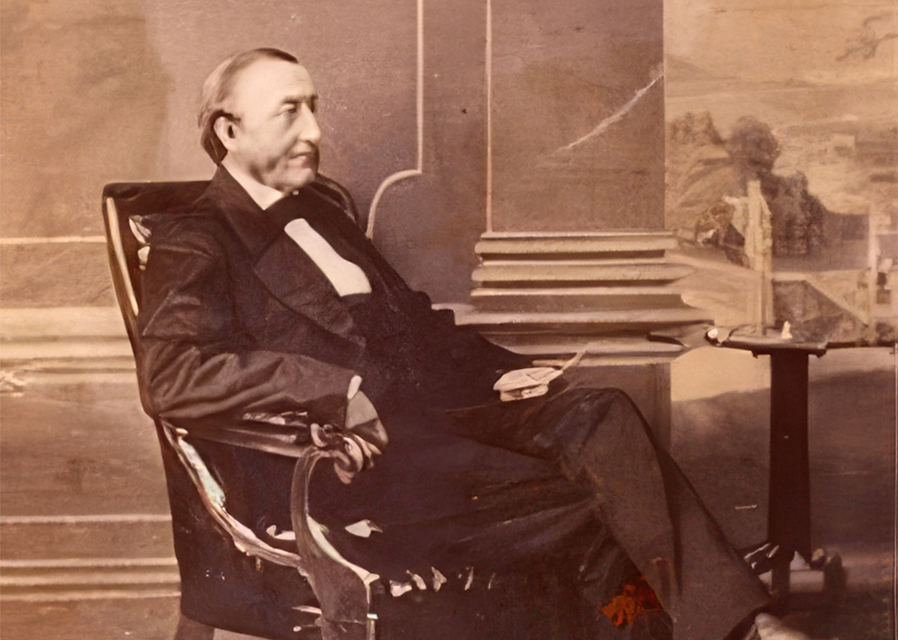
The sepia photograph I have depicts a middle-aged man, slightly angled in his chair, composed within the formal boundaries of a Victorian studio. There is no urgency in him, no sense that time is passing in the way we have come to understand it. In my study I also have copies of oil paintings, showing both Sir Charles and his wife, Lady Emma, in their younger years. Comparing the two sets of images is like witnessing the effects of a time machine.
The portraits do not tell the hidden story of what happened in between. One of travel and adventure, of great social change and deep personal tragedy. They remain silent, yet it is clear that time had already begun its work.
Sir Charles Anderson of Lea served as a Justice of the Peace for more than 60 years. For half a century he presided over the Quarter Sessions. He was embedded within the structures of local life – its governance, its expectations, and its sense of continuity. He was not an outsider looking in, but part of the system itself.
He was also a traveller. In both 1829 and 1852 he journeyed north into Scandinavia. The journal he kept from his later tour is not ambitious in the way we might now expect. It does not attempt to summarise or conclude. It does not seek to impose an overarching meaning upon what it records. Instead, it observes. The direction of the wind and weather. The behaviour of vessels. The arrangement of objects within rooms and the way collections are displayed and catalogued. In other words, it accumulates.
In Denmark he enters museums and studies collections. He admires not only the objects themselves, but the way in which they are ordered. The visitor is guided gently through time. Meaning is assigned through arrangement. It is an act of confidence. A belief that the past can be gathered and held. Yet the further he travels, the more something else begins to emerge. Not through declaration, but through repetition. Place names. Routes. Connections between one location and another.
In Copenhagen, Anderson found a city of museums, church towers, and halls of sculpture. He visited the Church of the Holy Trinity, whose spiral ascent once carried a Danish astronomer and alchemist towards the observatory above the city rooftops. From there, Sir Charles noted that the spires of Roskilde could be seen in the distance. Within the city itself, Anderson encountered the names that 19th-century Denmark most proudly carried into Europe: Bertel Thorvaldsen, Vilhelm Bissen and Hans Christian Andersen. The reference is almost incidental:
“Denmark may also boast of Hans Christian Andersen, whose delightful stories charm every reader. He was not in Copenhagen when I was there.”
The sentence lasts barely a moment before the journey moves onward, yet something about the absence feels strangely appropriate. Perhaps Sir Charles had hoped for an audience with the storyteller. Hans Christian Andersen belonged to movement. Railways, ferries, roads, hotels, and salons recur constantly throughout his diaries and fiction. Even his fairy tales seem suspended between worlds: childhood and adulthood, land and sea, memory and transformation.
Reading Sir Charles’s passing mention of Andersen while travelling through the same northern landscapes nearly two centuries later, I began to realise how many lives had moved through this corridor carrying stories with them. I often wonder whether the young Charles, staring back at me from his oil portrait, ever gave much thought to time itself.
Sir Charles and Lady Emma married in 1832 and had six children: three sons and three daughters. In a single year Sir Charles lost his wife, his sister and one of his daughters. All three of his sons would die within his lifetime, leaving no male heir to inherit either his title or Lea Hall. This is the hidden tragedy that lies between the two portraits.
I hold his journal in my hand, and it is strange how the words connect me to something familiar, yet from another age. From the moment he boards the Norwegian brig Thor until he sees the newly completed Grimsby Dock Tower beyond Spurn Point some eight weeks later, he repeatedly notices traces of connection. The persistence of names. The echoes of language. The suggestion that what appears familiar may have travelled from somewhere else.
The world through which he moved appeared rigid and stable. One of order, structure and empire. A world that could be arranged, like the collections he admired in museums. Systems that could be understood and retained. Each object given its place, each memory preserved.
There is little sense in his early writing that anything might disappear. Not his children, his wife and certainly not the places he recorded. There is no suggestion that landscapes might be altered beyond recognition or that communities might survive only in fragments of memory.
Perhaps Sir Charles believed that once fixed, memory could endure. Yet reading him now, it is difficult not to feel how much was already slipping away. Not lost entirely but altered. Displaced; removed from the context that once gave it meaning.
The world Sir Charles knew has largely gone. The corridor remains, but not as he saw it. When I first stepped into his voice on those winter evenings, I thought I was merely performing a role. I had no idea how many threads would later connect our lives. Like Anderson, I have travelled north through the Scandinavian lands that fascinated him. I have stood in Roskilde and Copenhagen. I have followed the same corridor of movement that carried him from the Trent towards the Baltic.
More strangely, I lived in a house he once owned. The connection is not mystical. It is simply one of place, memory and continuity. Yet through his journals and observations, Sir Charles has become a guide of sorts. A companion from another century. Having recently followed his 1852 journey, not by brig or steamer, but along the same routes; Schleswig-Holstein, Roskilde, and Copenhagen I felt the presence of the Victorian gentleman, and the distant echo of his name. Perhaps that is the real legacy of Sir Charles Anderson. The past is never quite as distant as we imagine.
Darron’s latest book, Where the River Meets the Sea, explores landscape, place, and memory. On Sunday 20th September at 12.00pm, experience a unique guided tour; Sir Charles Anderson – the life of a half-forgotten Victorian gentleman from Lea Park. This is a Heritage Open Day event. Numbers are strictly limited. Bookings through Eventbrite. For more information, visit the Delvers Facebook page or email chilcom@icloud.com.