
Set into the wall, close to the Old Hall, the plaque is easy to pass without noticing.
Gold lettering on blue enamel. A few lines of text that seem, at first glance, no different from the others placed across the town. It marks no surviving structure of importance – only a point in space, a location where something once happened. But the words it carries are unusually direct: 40 Day Capital of England.
It is the kind of statement that invites a second look. Not because it is exaggerated, but because it feels out of place. Nothing in the surrounding streets suggests a capital. There is no visible trace that a kingdom once gathered here. And yet, for 40 days in the winter of 1013–1014, it did.
The Delvers chose to record this moment not because it is widely known, but because it had been largely forgotten. For over 35 years, I have returned to the story of King Sweyn Forkbeard, first published in The Town on the Trent (Childs, 1990).
The blue plaques do not attempt to reconstruct the past in full. They identify a place where something significant occurred and allow the weight of that moment to settle quietly into the present. In this case, the story is both simple and disorienting.
Having been recognised as King of England, Sweyn of Denmark returned to Gainsborough, where his son Canute and his royal court were already established. Beside the river, he exercised his newly won authority. Forty days later, he was dead.
To understand why this happened here – and not elsewhere – it is necessary to shift attention away from the town itself and towards the river that runs alongside it. Once again, I find myself drawn back into the same line of enquiry – drawn once more along the same northern line, towards Germany and Denmark – in a continuing search to add substance to the story.
In the early 11th century, the River Trent was not a boundary but a route. It carried movement inland from the Humber, linking the North Sea world to the interior of England. Long before Sweyn’s arrival, it had already been established as a corridor of exchange, conflict, and control. Armies had moved this way before. The Great Viking Army had wintered at nearby Torksey in 872–73, leaving behind clear archaeological traces of a temporary but highly organised encampment. The line was known. The landscape was understood.
Sweyn’s arrival was not an intrusion into unfamiliar territory. It was a continuation of a pattern – movement along a corridor that had long connected England to Scandinavia. The place Sweyn selected for his headquarters was positioned at a natural meeting point along that route. It offered something more than geography. It provided access – to inland territories, to existing networks of loyalty, and to a kingdom already shifting beneath his influence. This was not a capital in the later, fixed sense. There were no permanent institutions of government, no defined seat of administration. Kingship, at this point, was mobile. Authority moved with the king himself, wherever he chose to establish his presence. For those 40 days, that presence was here.
The phrase ‘capital of England’ does not describe a place in the modern sense. It describes a moment – a temporary alignment of power, recognition, and location. A capital not of stone, but of circumstance. The historical record is brief.
The Anglo-Saxon Chronicle confirms Sweyn’s recognition and records his death soon after. Later accounts add detail, but none dwell on Gainsborough itself. The town appears only in passing – named, then left behind. This is often how such moments survive. Not through sustained attention, but through omission. A place enters the record once, then recedes. What remains is not a full narrative, but a gap. Standing before the plaque, it is possible to reconstruct something of that absence. The land beyond – later associated with the courtyard of the Old Hall – likely formed part of a substantial enclosed burh, a defended space capable of holding a royal presence. Here, authority would have been concentrated, if only briefly. The river, now contained within its banks, would have been busier then – wider, more active, carrying vessels inland and harbouring the Danish fleet. The surrounding ground, now settled into the rhythms of a modern town, may once have held a temporary concentration of people: loyal retainers, messengers, traders – those drawn towards the presence of a king.
For a brief period, decisions were made here that shaped the course of a kingdom. But the moment was not to last.
Sweyn’s death in early February 1014 shifted the centre of power once more. Although Canute was proclaimed king by the Danish army, his authority was contested. The political balance had already begun to move. Within weeks, the Danish fleet withdrew. Canute would learn from that brief and uncertain moment. Within a year, he returned to complete what had been started – this time establishing an enduring North Sea empire that bound England and Denmark together.
That later story – more stable, more visible – has naturally drawn greater attention. But it risks obscuring what came before. The forty days remain a threshold: the point at which one order ended and another began, held briefly in a place later shaped by memory. What makes this episode compelling is not simply that it happened, but that it did not last.
History tends to favour what endures – structures, institutions, reigns measured in decades. But there is another kind of significance, found in moments too brief to leave obvious traces. Gainsborough’s role in the winter of 1013 belongs to that quieter category. It reminds us that power is not always fixed. That it can gather, briefly and unexpectedly, in places that can appear entirely unremarkable. That a town can stand at the centre of events, only to return to the margins. There is nothing here that insists on remembrance. The Delvers plaque does not attempt to resolve that tension. It does something simpler. It fixes the moment to a place. It marks the point at which a king stood, a kingdom gathered, and time briefly converged. Forty days. Nothing more.
And yet, without the Delvers blue plaque, it would be easy to forget it happened at all.
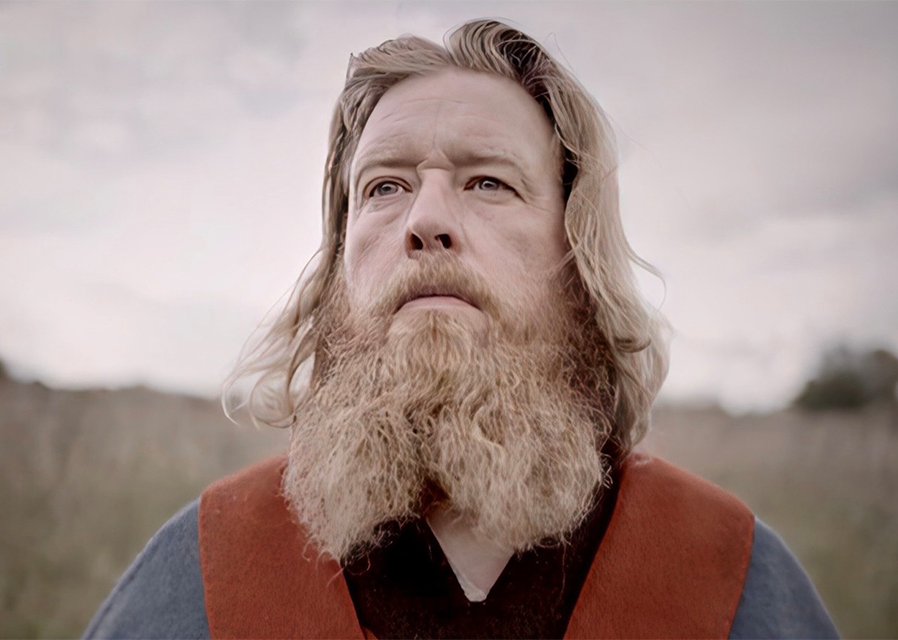
Image: Danish TV