
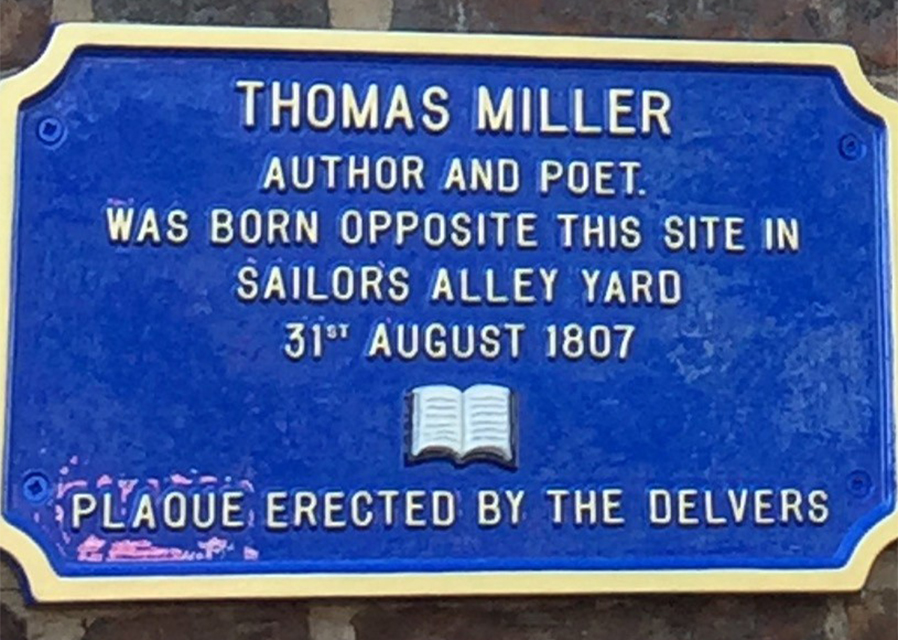
Some names slip quietly out of a town’s everyday memory, even when they once carried real weight. Thomas Miller is one of them. His name is no longer widely spoken, yet in the 19th century he was read across Britain as a poet, novelist and chronicler of ordinary life. The blue plaque to Thomas Miller was the first to be erected by the Delvers in August 1997. It reminds us that Gainsborough was not only a river port and busy market town, but also the birthplace of a writer who rose from extreme hardship to literary distinction.
Miller was born on 31st August 1807 in Sailors’ Alley, just off Bridge Street. The plaque stands opposite the site of his birth because the original yard has long since disappeared. The Delvers plaques do not simply celebrate famous people; they recover the relationship between a life and the streets in which it began.
Thomas Miller’s childhood was shaped by insecurity. His father, George Miller, a wharfinger, disappeared in London in April 1810 during the Burdett Riots and was never heard from again. The family was left in poverty. Miller later grew up in the close-packed working yards of old Gainsborough. He had little formal schooling and was apprenticed to manual trades, but he developed an intense love of reading and writing. In this, he belonged to that remarkable class of self-taught 19th-century writers who created their art not from privilege, but from persistence.
In his lifetime he was known as “the basket-maker poet”, as before he became established in literary circles, he worked as a basket-maker in Gainsborough, Nottingham and later London. Yet it was precisely his knowledge of working life and provincial experience that gave his writing its texture.
There is also something fitting in the fact that he came from Gainsborough. In the early 19th century the town was still deeply tied to the Trent. This was a place of wharves, carriers, workshops, hostelries and river traffic. Goods moved through it, but so did people, ambition and ideas. Miller later recreated this world in Our Old Town, published in 1857, which looked back with affection and sharp observation of his youth.
Miller’s route into print began in Nottingham. While working there as a basket-maker, he came to the attention of Thomas Bailey, editor of The Good Citizen, who encouraged him to publish his first book, Songs of the Sea Nymphs, in 1832. It was an improbable beginning for a young working man from a riverside yard in Gainsborough, but it proved decisive. A few years later he moved to London, continuing at first with his trade while trying to establish himself as a writer.
From there his literary career broadened steadily. He published poetry, sketches, tales and novels, including A Day in the Woods in 1836, dedicated to the Countess of Blessington, Beauties of the Country in 1837, and Gideon Giles in 1841. He also wrote for periodicals and annuals, gradually building a reputation among Victorian readers.
Later accounts record that he contributed to journals including the Literary Gazette, Chambers’s Journal, Household Words and the Illustrated London News.
What makes Miller especially interesting is the kind of writer he became. He was never simply a metropolitan author who left his beginnings behind. He constantly returned to the textures of common life: the countryside, labour, memory, hardship, companionship and the fragile dignity of poor households. He belongs to a wider 19th century tradition of socially attentive writing (1 Ashton and Roberts, 1999) but he also stands apart because he wrote from lived experience rather than distant observation. That is the main reason the Delvers chose Miller to be the recipient of the first blue plaque. I
L Miller resists the idea that the past belongs only to exceptional people sealed off from ordinary life. His story began in one of the humbler parts of old town. He knew insecurity at first hand. He learned a trade. He made things with his hands. And yet he also wrote more than 40 volumes and earned admiration in Victorian literary circles. His story enlarges the idea of who is worth remembering.
The life of Thomas Miller shows that old Gainsborough produced not only merchants, mariners and craftsmen, but a serious man of letters whose work carried traces of the town far beyond Lincolnshire. There is another local resonance too. Miller grew up next door to Thomas Cooper, the future Chartist and writer. That small fact hints at the intellectual energy that could emerge from even the poorest environments.
In the end, the Delvers Blue Plaque to Thomas Miller does more than identify a birthplace. It tells us that literature, like history itself, does not only come from capitals, universities or great houses. Sometimes it begins in a narrow yard by the river, in a town people think they already know.
That is why the Delvers blue plaques matter.
1 Ashton, O. and Roberts, S. (1999) The Victorian working-class writer. London: Cassell.