
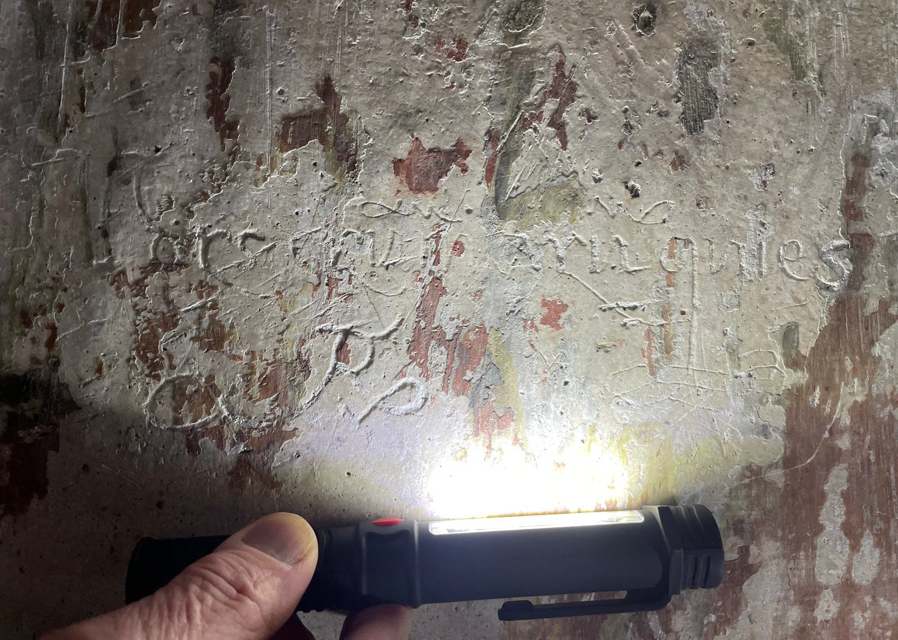
Recent research at Gainsborough Old Hall has uncovered a remarkable collection of carved ritual protection or apotropaic marks (sometimes referred to as ‘witches marks’), marking one of the largest such discoveries among English Heritage’s 400 sites.
Over the past two years, Rick Berry, a long-time English Heritage volunteer, has discovered and mapped approximately 20 carvings at the Tudor property, famously visited by Henry VIII and Catherine Howard.
The array of designs found at Gainsborough includes a particular concentration of marks in the servants’ wing. Among these are six-petalled flowers within a simple circle, known as daisy wheels and hexafoils,
which were believed to trap demons. Other designs include overlapping Vs or Marian marks, thought to invoke the Virgin Mary for protection, and a pentangle, a symbol historically used to ward off evil, despite its modern associations.
In addition to these protection marks, researchers have also identified rare ‘curse’ inscriptions, likely created during the ownership of William Hickman, who acquired the property in 1596. Though curse inscriptions are more commonly linked to the Roman and Anglo-Saxon periods, one at Gainsborough uniquely features Hickman’s name written upside down. This act of defacement was traditionally believed to curse the named person and represents a first for English Heritage sites.
Gainsborough Old Hall is further safeguarded by approximately 100 burn marks, thought to have been created to protect against fire, making it one of English Heritage’s most ‘protected’ sites.
Kevin Booth, English Heritage’s Head of Collections, commented: “It is astonishing that, centuries later, the incredible old buildings in our care continue to reveal their hidden secrets. The Old Hall has undoubtedly witnessed a turbulent history, particularly under the ownership of the apparently unpopular William Hickman. However, why it displays such a high concentration of protective carvings remains a mystery. Our dedicated volunteer team across the country plays a crucial role in these discoveries, and Rick’s enthusiasm for Gainsborough has been instrumental in uncovering these remarkable marks.”
Other English Heritage properties with previously identified protective carvings include Boscobel House and The Royal Oak, Bolsover Castle, Cleeve Abbey, Kirby Hall, Harmondsworth Barn, Stokesay Castle, Audley End, and Deal Castle.