
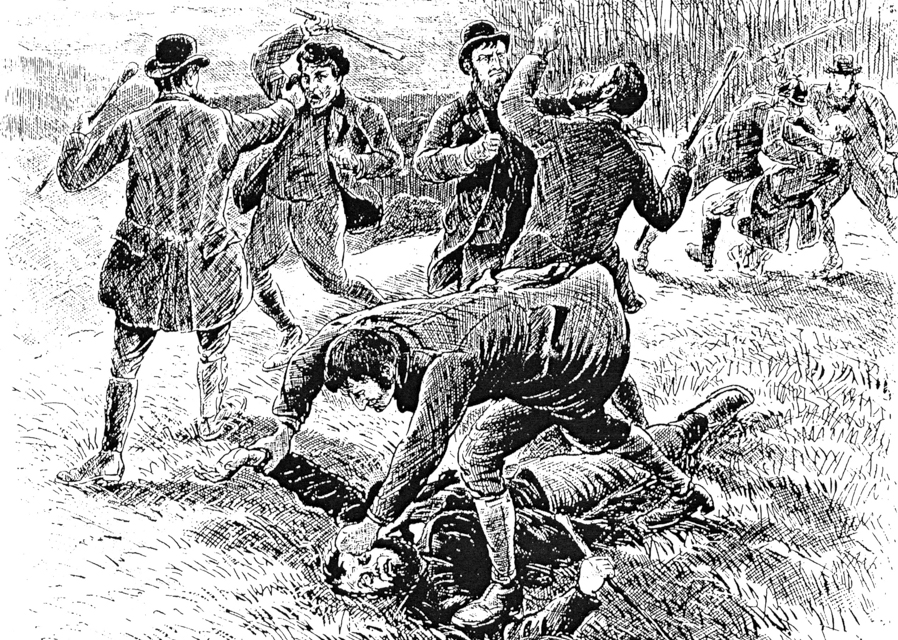
Life in Nottinghamshire for working families in the early days of Queen Victoria’s reign could be tough. The main industry, framework knitting, was in decline and open to the exploitation of employers. Families had little money to buy food. At the same time, they were living alongside open forest that was full of wild animals and birds, a plentiful source of protein. However, due to the imposition by the land owners of the enclosures and game acts, the hunting of these creatures was against the law and could invoke very severe punishment. The aristocratic land owners employed gamekeepers to ensure that their bucks and does, pheasants and hares, were kept for the pleasure of their families and friends on the occasional organised hunt.
So it was on the night of Monday 13th October 1851 that a group of over 30 men from the Mansfield and Sutton in Ashfield area made their way, under the light of a full moon, into an area of the forest owned and enclosed by the Earl of Scarbrough: Rufford Park. Their intent was to seize pheasants and hares to feed their families. The Earl’s gamekeepers were employed to make sure that they did not. There had been many encounters before and both sides knew that no quarter would be asked for, nor given, should the two sides meet.
The keepers knew that the poachers were coming. They were experienced woodsmen and had a good idea of where their adversaries would be. All were equipped with long flails; two had pistols at the ready. The poachers collected smooth heavy stones to defend themselves should they be attacked.
Alongside the Mansfield to Bilsthorpe Road, hidden by the thick gorse, 10 keepers lay in wait as the poachers came past to set their nets. Two of the poachers lingered behind the others, fixing posts into the ground. At a signal from head keeper Fred Brock, the keepers crept out from their hiding place, ready to drive the poachers away using whatever force was needed. As they approached they were spotted. The poachers ran to join their colleagues. The keepers now charged forward to catch up with them.
The flails beat down on the two but not before they had been able to signal to their friends. Through the air the heavy stones fell like hail onto the keepers. All were injured, some were knocked out and one, William Roberts, received a serious blow to the head. The two sides closed in on each other. Flails, fists and stones flew in all directions. One stone hit the pistol that was held in Fred Brock’s waistband, firing the bullet into the ground. He was so engaged in the battle that he didn’t realise until his colleague, Sam Herod, shouted that the flash had set his trousers on fire!
The fight went on for 10 minutes before the poachers gathered up their wounded and disappeared into the forest.
The authorities were quick to act. Within a few days, working on past evidence and interviews with the keepers, Police Constables Parry, Kirk, Radford and Bishop had arrested 13 suspects and put them before the Magistrates Court in Mansfield. The charges were serious. The badly injured keeper had died of his wounds.
There was enough evidence to send six of the defendants for trial at the Courts of Justice in Nottingham charged with manslaughter, assault, wounding and entering enclosed lands. Such was the law at the time that the crime of entering enclosed lands carried greater punishment than assault or wounding.
At the trial George Robinson and Thomas Alvey were immediately discharged through lack of evidence, leaving George Dunlop, Samuel Sims, George Bowskill and John Moakes to face the court. At the end of the day Francis Grammer stood up to give the verdict of the jury. Guilty on all counts. Though there was plenty of evidence to show that one of the defendants, George Bowskill, was nowhere near the incident, he and three others were sentenced by Chief Justice Jervis to 14 years transportation, ‘beyond the seas.’
So; heroes or villains? A song, written at the time, speaks of ‘gallant poachers,’ of pheasants and hares being, ‘quite equal for to share.’ There was little, however, in Victorian times that was equal, nor were the land owners willing to share. Both groups of men in the story were doing what was right for them; the poachers providing food for their families by taking the wild game on enclosed land, the gamekeepers providing food for their families by obeying the orders of their employers. One side risked severe punishment, the other would have seen their families out of house and home should they disobey.
Were your ancestors involved? What happened to next to those sent ‘beyond the seas’?
You can find out in the booklet Rufford Park Poachers by Sam Millard, available at local museums and outlets or via eBay. Sam has presented this story to over 40 groups in Nottinghamshire and beyond and is always happy to share his knowledge. to make a booking for this popular talk email sammillard123@btinternet.com.