

Whilst the weather through the seasons might no longer seem as distinct as it once did, nature at least is a little more consistent. So, whilst we might have no idea what weather to expect in March, there are some natural marvels we can reliably look forward to seeing.

Wood anemone, Mark Hamblin
From butterflies to blossom, birds busying themselves with breeding to boxing hares and bats, there is something for everyone.
I often make a special effort in March to head to my favourite hare watching spot and whilst I am often treated to good views of these fascinating creatures, I’ve never been lucky enough to see hares boxing – but I live in hope. If you are keen to see hares, it’s best to look for a spot where they enjoy feeding as once they are on the move at speeds of up to 45 miles per hour, you won’t catch more than a fleeting glimpse.
One of the delights of the season that’s easier to spot, given that it is both plentiful and stationary is blackthorn blossom. Unlike most trees, the blossom of blackthorn appears before the leaves. This quirky feature gives rise to the phrase ‘blackthorn winter’ when hedgerows filled with blossom can look like they have been dusted with a covering with snow.
Another flower that can give the impression of a dusting of snow is the wood anemone. I once arrived at our Eaton Wood Nature Reserve and at first glance thought the woodland floor was white with snow. On closer inspection there was an amazing display of wood anemones.
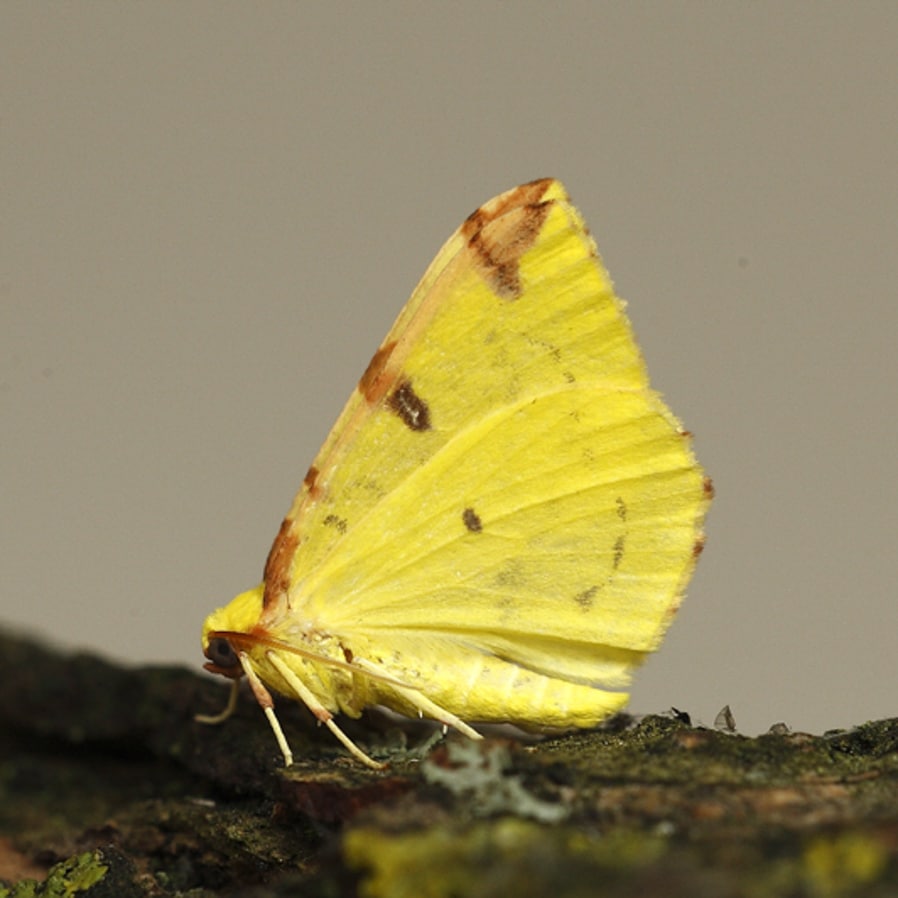
Brimstone Moth, Sean Browne
As well as providing a splash of flowers, blackthorn is a vital plant for wildlife throughout the year. Its delicate white flowers provide a source of nectar for insects in early spring when few other species are flowering. Its thorny branches provide added safety for nesting birds and brown hairstreak butterflies often lay their eggs on the fresh shoots in spring. At the back end of the year, the blackthorn fruits, known as sloes, provide food for a range of birds.
Speaking of birds, one of the first birds to arrive from Africa in spring is the chiffchaff, easily identified by their onomatopoeic ‘chiff-chaff, chiff-chaff’ call in woods, parks and areas of scrub.
As the warmer weather does begin to arrive its worth looking out for brimstone butterflies as they emerge from their winter hiding places – a sure sign that spring is on its way. Other early butterflies – species that spend the winter as adults, include red admiral and peacock.
Once the weather is warm enough to tempt insects to fly, bats are likely to emerge in evenings – with common pipistrelle bat the species you are most likely to see.
With such a variety of flowers, insects, birds and other wildlife to take in, March really is the month that signals the arrival of spring and turning the page on the calendar this month should really be a great motivator to get out and about to see what Mother Nature has to offer after the cold dark days of winter.
Idle Valley Nature Reserve Spring Festival: Friday 5th – Sunday 7th April
Join Nottinghamshire Wildlife Trust at our largest nature reserve for a full weekend celebrating nature with family activities, beaver talks, optics demos, lambing and a craft fair. For further details visit www.nottinghamshirewildlife.org/events.
Main image: Chiffchaff, Mike Vickers